
Patent Pending — Do Not Copy
This demonstration reflects proprietary SEDAC LLC intellectual property protected under pending U.S. patent applications and established prior-art publication dates. We are aware that this material has been accessed for purposes of imitation. Copying, adapting, or commercializing the architecture, schema design, task-module structure, or CDRL generation method shown here — without a license from SEDAC LLC — exposes you to patent infringement liability upon issuance. If you are interested in licensing, contact us.
© 2026 SEDAC LLC.
The Difference Between "System Shall Comply With 882E" and a Hazard Tracking System That Survives Review.
Task 106 is not a checkbox. It is a CDRL deliverable with a DID. This article explains in plain English the full scope of crafting a single MIL-STD-882E Task 106 compliance CDRL.
There is a phrase that appears in nearly every defense aviation program’s system safety plan.
“This program shall comply with MIL-STD-882E System Safety.”
It appears in SOWs, in technical proposals, in CDRLs. It is stated at program kickoffs. And in a meaningful percentage of Army aviation and UAS programs, when a government safety reviewer asks to see the specific deliverable that Task 106 requires, Hazard Tracking System, more often than not what they get is not a document. Instead, they get an explanation of why the document doesn’t exist yet.
What Task 106 Actually Requires.
MIL-STD-882E is structured as a menu of 41 tasks, each producing a specific deliverable. Task 106 is the Hazard Tracking System, or a data system maintained throughout the program lifecycle that tracks every identified hazard from first identification through resolution.
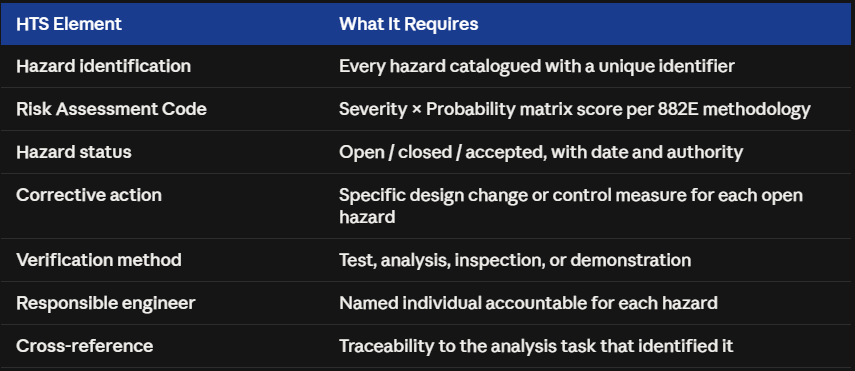
The CDRL deliverable for Task 106 points to a specific DID. That DID specifies exactly what the HTS document must contain.
How Long It Actually Takes.
The most credible outside estimate of manual hazard tracking cost comes from a competitor’s own patent filing.
“Before such tools existed, generating a single formal hazard analysis report by hand normally took hundreds — and sometimes over a thousand — personnel-hours.”
— Northrop Grumman Corporation, USPTO Publication No. US 2007/0276679 A1
Northrop built a tool to solve this for themselves in 2007. This is not SEDAC's claim but an actual Defense Prime contractor's own sworn estimate of the manual labor burden for the exact deliverable class Task 106 produces.
The XM30 Warning.
The consequences of an unmanaged systems-engineering deliverable never stay within the bounds of a safety plan. The most thoroughly documented recent example is the XM30 Mechanized Infantry Combat Vehicle, colloquially known as the Army’s Bradley replacement, developed as a “born digital” MBSE program.
“Program officials stated that they assumed the contractors had some degree of proficiency in using a models-based engineering approach. Building and maturing the system architecture model resulted in significantly more growth in data and specifications than program officials anticipated.”
— GAO-25-107569, Weapon Systems Annual Assessment, June 2025
Net effect: Milestone B slipped by over a year. The DoD IG opened a separate investigation. As of March 2026, Army leadership had not signed the documentation finalizing the decision. A Bradley follow-on in development since 2018 is now looking at FY2028 production. Assumed compliance. Unverified artifacts. Same failure mode.
The Gap: Claimed vs. Documented.
“This program shall comply with MIL-STD-882E System Safety” is a claim about intent. A Hazard Tracking System that survives T&E review is a monolithic document that is structured, current, traceable, formatted to the DID, and readable by a government reviewer who has never spoken to your program team.
On an AQL-3 small UAS pursuing an Army AWR, a properly documented 882E workstream including Task 106 runs to roughly 1,200 baseline labor hours manually. On a medium Group 3–4 platform, approximately 2,000 hours. The deliverable costs that much because the DID requires that much content to be defensible.
What the SEDAC Task 106 HTS Tool Does.
SEDAC built a browser-based Task 106 tool. Live. No install. No Cameo license. It produces structured HTS output formatted to the CDRL deliverable requirement — RACs computed, cross-references maintained, hazard status tracked through the lifecycle.
Note: The underlying SysML architecture driving SEDAC's HTS methodology is proprietary. The tool is the interface. The model is not available for inspection. Commercial licensing terms available by request.